6601 Lyons Rd. Suite C4 Coconut Creek, Florida 33073
Mon-Fri 08:00 AM - 05:00 PM
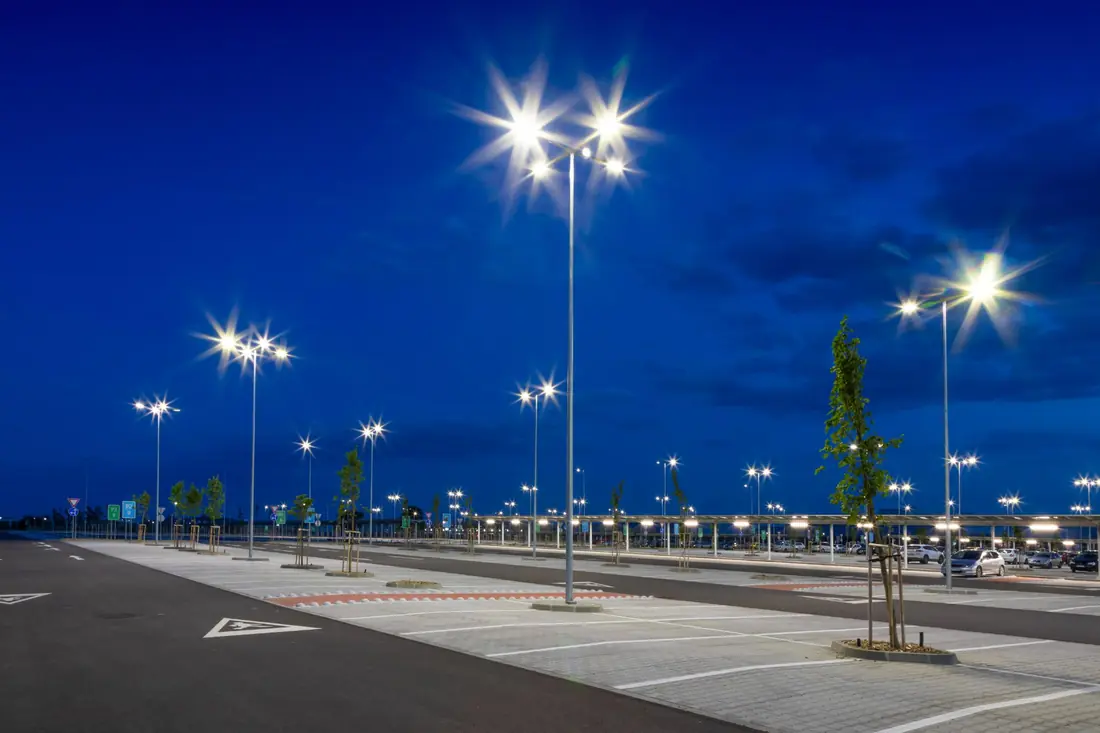
A better-lit property starts in the parking lot.
It is the first thing your tenants see and the last thing your customers walk through. We repair it, convert it, rebuild it, and when it keeps going dark we trace the fault all the way back to the panel.
A lot with three dark poles reads as neglected no matter how well the buildings are kept. It affects how safe people feel walking to their cars, what your cameras can actually record after dark, and what a prospective tenant thinks before they reach the front door.
We handle site lighting end to end. Repairs and fixture replacement, LED conversions, new systems on properties that never had enough coverage, and the electrical troubleshooting underneath all of it when the same section keeps going out.
A lighting vendor replaces the head and leaves. If the fault is upstream, you are dark again in a month and paying for the same fixture twice. We are licensed electricians, so we can follow the whole circuit. Select a stage to see what fails there.
Where the site lighting circuit starts. A breaker that trips every few nights, a failed breaker that never resets, or a lighting circuit that was undersized when the lot was expanded years ago.
What decides when the lot turns on. This is the single most common cause of lighting complaints and it has nothing to do with the fixture. A welded contactor, a failed photocell or a time clock that lost its schedule after an outage.
The part nobody wants to find, and the reason a lot can eat fixtures for years. Water in the conduit, corroded splices in a junction box, a conductor nicked during landscaping or a section faulted after a storm.
Inside the shaft and at the hand hole. In-line fuses blow for a reason, and standing water at the base corrodes connections long before anything looks wrong from the road.
Sometimes it really is the fixture. A failed driver, a dead LED module or a lamp and ballast at the end of a long life. We confirm it is the fixture before replacing one, instead of assuming it.

Most contractors will replace what they can see and stop there. Underground faults take testing equipment, patience and a license, so they get quoted as a full rewire or deferred another year.
We isolate the fault first. That usually means a bad section, a single junction box or one damaged conductor, not the whole lot. Knowing which one is the difference between a repair and a rebuild.
Before anyone drives out, the way the lights are failing narrows down where to look. This is what we ask about when you call.
Getting what you have working again, from the fixture down to the circuit feeding it.
Moving the lot off metal halide and HPS, with controls that match how the site runs.
New coverage where the lot was never lit properly, or poles that have to come out.
Catching failures on a schedule instead of hearing about them from a tenant.
Building recertification in Miami-Dade and Broward includes an electrical safety inspection and a parking lot illumination certification signed by a licensed engineer. Salt air corrodes poles at the base plate and anchor bolts, and a pole that looks fine at eye level can be gone where it counts. We inspect the poles, the circuits and the light levels, then price whatever gets flagged.

A daytime walk tells you nothing about coverage. We inspect lots after dark, when the controls have switched and every fixture is either working or it is not.
Because the fixture probably is not the problem. Repeat failures on the same pole or the same run usually point to a wiring fault, a bad connection or water in the conduit feeding it. Each new fixture fails into the same fault.
Not to find it. We test to isolate which section or junction is bad before anything is opened up. Sometimes a repair means one excavation at one point, and sometimes it means pulling new conductor through existing conduit with no digging at all.
Yes. We cone off only the area under the truck and work pole by pole. For busy retail and restaurant sites we usually run the work overnight so the lot is clear before opening.
A walk of the property with the lights on, counting fixtures, noting what is out, checking the controls and measuring coverage. You get a written list by location and a scope for whatever you decide to fix.
That is a design problem rather than a repair problem. It usually means pole spacing or fixture selection no longer suits how the lot is laid out, often after a re-stripe or an expansion. Adding poles or changing optics fixes it.
Both. Plenty of properties start with a single repair call. Many then move to scheduled night inspections once they see how many fixtures were out that nobody had reported.
We will inspect the lot with the lights on, tell you what is actually failing and where in the circuit it sits, then quote only what needs doing.
Send the property address and what you are seeing. Photos from the lot help.
Get a Free Quote